Courier Delivery Fleet Management: The Complete Guide for Fleets Serving Multiple Restaurants
August 17, 2026· 10 min read
Courier delivery fleet management is the discipline of running a group of couriers — often for several restaurants at once — as one predictable operation: every ready order reaches the right rider without a phone call, every rider and order is visible on a live map, every delivery is logged with how it was paid, and every restaurant and every courier gets an accurate statement at the end of the period. This guide explains what that covers in practice, which numbers actually matter, how billing works between a fleet and its restaurants, the mistakes fleets make while scaling, and a checklist for choosing software. At the end, we show how implements each piece.
If you run — or are about to run — couriers for more than one kitchen, this is written for you.
What courier delivery fleet management actually covers
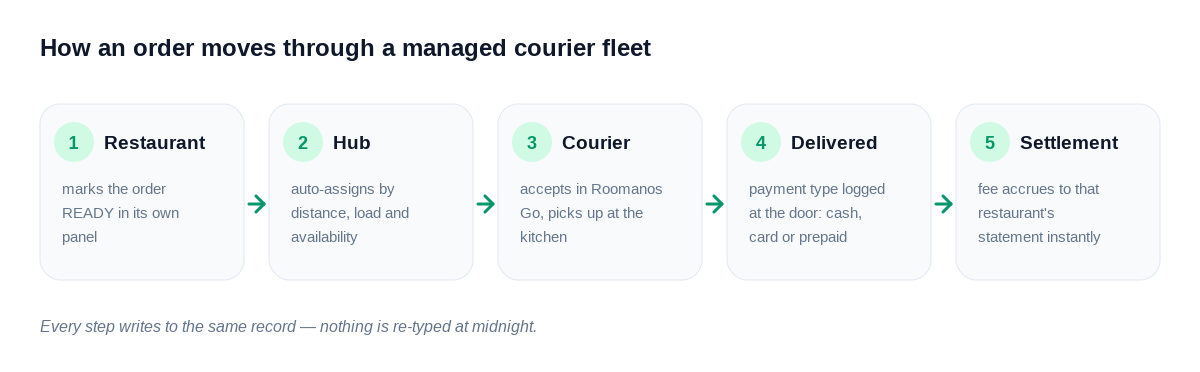
The phrase gets used for everything from a GPS tracker to a full logistics platform. For a fleet that serves restaurants, it comes down to five connected pieces. If one is missing, the other four leak.
1. Order intake and dispatch. Orders have to arrive in the fleet's system on their own — from the restaurant's panel, not from a WhatsApp message — and be assigned to a courier the moment they are ready. Assignment can be automatic (by distance, load and availability) or manual, but it has to be recorded, not remembered.
2. Live visibility. One map with every courier and every open order. Not for watching people; for never having to call anyone to ask "where are you?" — and for the restaurant never having to call you.
3. The courier app and proof of delivery. Riders need a phone app that receives assignments, confirms pickup, confirms delivery and records the payment type (cash, card at the door, prepaid) at that moment. This is where the month's numbers are born; if it is done later from memory, the numbers are wrong.
Run your business with Roomanos
Find the Roomanos app that fits your business. Get started in minutes.
4. Restaurant billing and settlement. With multiple kitchens, revenue is per restaurant, and so is the invoice. Fees have to accrue per delivery, per restaurant, per tariff, as they happen — so a month-end statement is a report you open, not a weekend you spend.
5. Courier earnings and shift reporting. Each rider's deliveries, earnings, cash collected and cash owed, closed out with an end-of-day report. This is what keeps couriers with you and keeps disputes short.
Notice that every step writes to the same order record. That single fact is what separates a managed fleet from a busy one: nothing is re-typed, so nothing is lost between the kitchen and the invoice.
Manual vs. automatic dispatch — and how the decision is made
Most fleets start with a dispatcher assigning by hand. It works at low volume and breaks quietly at peak: the dispatcher guesses who is closest, sends a rider across town while another idles two streets from the kitchen, and forgets which order was cash.
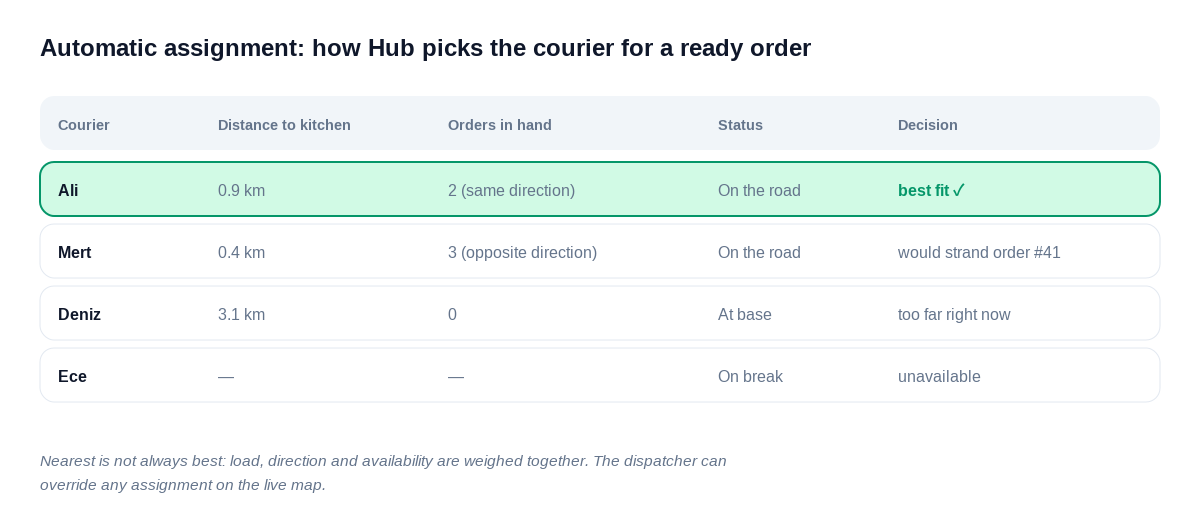
Automatic assignment replaces the guess with a rule. When a kitchen marks an order ready, the system scores available couriers by distance to that kitchen, orders already in hand and their direction, and current status — and assigns the best fit.
The nearest rider is not always the right one: a courier 400 metres away carrying three orders in the opposite direction will strand them all. Good software weighs load and direction, not just distance — and still lets the dispatcher override any assignment on the live map. Auto by default, human when needed.
The numbers that matter
You cannot manage what you only feel. These are the metrics a courier fleet should see every day, why each matters, and which way is healthy.
Metric
Why it matters
Healthy direction
Deliveries per courier-hour
The single best productivity number; too low means idle riders or bad assignment
Up
Ready-to-pickup time
Minutes an order waits at the kitchen after "ready" — this is what restaurants complain about
Down
Ready-to-delivered time
The customer's experience of your fleet
Down
Idle time per courier
Paid time with no order in hand; usually an assignment problem, not a rider problem
Down
Cash variance
Cash collected per app vs. cash handed in; should be zero every night
Zero
Cancellations per restaurant
Points at a kitchen problem, a menu problem or an address problem
Down
On-time rate per restaurant
Your argument at contract renewal
Up
Two of these deserve emphasis. Ready-to-pickup is what your customers — the restaurants — actually feel; a fleet that averages 12 minutes here will lose the account to one that averages 6. And cash variance is where fleets bleed silently: if payment type is not captured at the door, the reconciliation at midnight is a negotiation.
How billing works between a fleet and its restaurants
This is the part most "delivery software" ignores, and it is where multi-restaurant fleets earn or lose their margin.
Pricing models. In practice there are three:
Flat fee per order — simple, predictable, easy to invoice. Works when delivery zones are similar.
Per-kilometre — fair when restaurants have very different radii; requires reliable distance measurement from kitchen to door.
Hybrid — a base fee plus a distance component, or a monthly minimum plus per-order.
Whichever you pick, the tariff should be settable per restaurant, not fleet-wide. Your oldest partner and your newest trial account should not be forced onto the same price.
Contracts. A fee is a promise; put it in a mutual agreement both sides accept in the system — including notice periods and what happens on early termination. When both parties can see the same terms, month-end disputes mostly disappear.
Statements. Fees should accrue the moment a delivery is assigned or completed, into an itemised statement per restaurant: date, order, courier, distance if relevant, fee, cancellations. Settlement is then a report, not a reconciliation project.
The courier side. The same logic applies to your riders: per-delivery earnings, any compensation agreements, cash collected vs. owed — snapshotted at delivery time and closed daily. Fleets that settle couriers transparently keep their couriers.
Six mistakes fleets make while scaling
Dispatching in WhatsApp. It has no state. Nobody knows what has been assigned, what was picked up, or what was cash — until someone scrolls.
One tariff for every restaurant. You either overcharge your best account or subsidise your worst.
Recording payment type "later". Later is midnight, and midnight is from memory.
Skipping the daily close. Without an end-of-day report per courier and per restaurant, small errors compound for thirty days and land in one argument.
Riders on personal chats instead of an app. No proof of pickup, no proof of delivery, no timestamps — nothing to stand on when a restaurant disputes an order.
Treating the live map as surveillance. It exists to stop the "where are you?" calls, and to let a restaurant see its own order. Frame it that way to your riders and adoption stops being a fight.
Choosing courier fleet management software: a checklist
Ask each vendor these questions. A good product answers "yes" to at least eight.
Can one fleet serve many restaurants, each with its own orders, tariff and statement?
Do orders arrive automatically from the restaurant, without re-typing?
Is assignment automatic by distance, load and availability, with manual override?
Is there a live map of every courier and every order?
Do couriers get a mobile app with pickup/delivery confirmation and payment type capture?
Do fees accrue per delivery into a per-restaurant statement?
Can I set a different tariff per restaurant (flat, per-km, hybrid)?
Are fleet↔restaurant terms held as a mutual contract in the system?
Is there an end-of-day report per courier and per restaurant?
Can a restaurant connect itself to my fleet without a call to me?
How Roomanos Hub covers each piece
We built Roomanos Hub as the operations center for exactly this kind of fleet — one team of couriers, many restaurants. Mapping it to the five pieces above:
Intake & dispatch: restaurants connect to your fleet from their own Roomanos panel; when a kitchen marks an order ready, Hub auto-assigns it to the best available courier by location and availability, and the dispatcher can override on the map.
Live visibility: every courier and every order on one real-time map.
Courier app: riders join with a connection code and work from the Roomanos Go app — assignments, pickup, delivery and payment type on their phone.
Restaurant billing: per-order or per-kilometre tariffs, settable per restaurant; fees accrue as deliveries happen; itemised statements per restaurant; mutual fleet↔restaurant contracts with proposal and acceptance on both sides.
Courier earnings & shift close: per-courier earnings and settlements, and a fleet end-of-day report that closes the shift.
Hub is built for courier fleets serving several restaurants at once — regional courier networks, and chains that spread their own riders across branches. If you are a single restaurant with two riders, you don't need a fleet operations center; Roomanos Kitchen already assigns couriers from the kitchen screen.
Getting started in one week
You don't need to migrate anything to try it.
Day 1 — open Hub, create your fleet, set a default tariff.
Day 2 — invite couriers with a connection code; they install Roomanos Go.
Day 3 — connect your first restaurant (they link from their own panel); run one evening in parallel with your current method.
Day 4–5 — switch that restaurant fully; watch ready-to-pickup and cash variance.
Day 6–7 — add the next restaurants and set per-restaurant tariffs; run your first end-of-day close for the whole fleet.
If you'd rather see it first, request a demo and we'll walk through your evening rush together. Fleet pricing is on the pricing page.
Frequently asked questions
What is courier delivery fleet management software?
Software that receives ready orders from restaurants, assigns them to the right courier automatically, shows every rider and order on a live map, records each delivery with its payment type, and produces per-restaurant and per-courier statements — replacing the phone-plus-spreadsheet way of running a fleet.
Can one fleet deliver for many restaurants in Roomanos Hub?
Yes — that is the core use case: one operations center, many restaurants, with tariffs, earnings and invoices computed separately for each restaurant.
How does automatic assignment decide which courier gets an order?
By distance to the kitchen, orders already in hand and their direction, and current availability. The nearest rider isn't always chosen; the dispatcher can override any assignment on the live map.
Which pricing model should a fleet use with restaurants?
Flat per-order fees for similar zones, per-kilometre when radii differ a lot, hybrid when you need a base plus distance. What matters more is that the tariff can be set per restaurant and is held as a mutual contract.
How do couriers join the fleet?
Each courier receives a connection code and joins from the Roomanos Go mobile app. Assignments, pickups, deliveries and payment types are handled on their phone.
How is billing settled between the fleet and each restaurant?
Fees accrue as deliveries happen into an itemised statement per restaurant, so month-end settlement is a report you open rather than a reconciliation project.